Icosahedron
An icosahedron is the dual of a dodecahedron: each dodecahedron face center becomes a vertex; the three centers around each original dodecahedron vertex become one triangle.
Steps:
- Find every dodecahedron face center.
- Normalize those centers to the unit sphere → 20 vertices.
- Group the three centers around each original dodecahedron vertex (corner) → 20 faces.
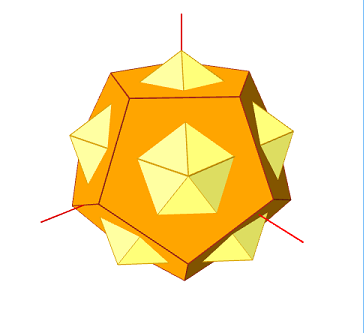
The yellow icosahedron appears if you remove the orange reference dodecahedron.
Add the icosahedron module
src/lib.rs additions:
#![allow(unused)]
fn main() {
use truck_meshalgo::prelude::*;

// ...keep earlier functions through dodecahedron...
pub mod icosahedron; // add this
pub use icosahedron::icosahedron; // add this
}
Construct Main Function
src/icosahedron.rs:
#![allow(unused)]
fn main() {
use truck_meshalgo::prelude::*;

/// Icosahedron via dual of a dodecahedron.
pub fn icosahedron() -> PolygonMesh {

    //PLACE STEPS 1-5 HERE

}
}
Step 1: Start from a dodecahedron
#![allow(unused)]
fn main() {
    let dodeca: PolygonMesh = crate::dodecahedron();
    let d_positions = dodeca.positions();
}
Step 2: Build vertex positions from face centroids
#![allow(unused)]
fn main() {
    let positions: Vec<Point3> = dodeca
        .face_iter()
        .map(|face| {
            let centroid = face
                .iter()
                .map(|v| d_positions[v.pos].to_vec())
                .sum::<Vector3>();
            Point3::from_vec(centroid.normalize())
        })
        .collect();
}
How this block builds icosahedron vertices
dodeca.face_iter()iterates over each pentagonal face of the source dodecahedron.- For each face we grab its five vertex positions from
d_positions, convert them to vectors, and sum them to get the face centroid vector. centroid.normalize()projects that centroid direction onto the unit sphere so every new vertex sits on radius 1.Point3::from_vec(...)turns the normalized direction back into a point; collecting the results gives the 20 icosahedron vertex positions.
Step 3: Build faces by collecting touching centroids
#![allow(unused)]
fn main() {
    let mut faces: Faces = (0..20)
        .map(|i| {
            dodeca
                .face_iter()
                .enumerate()
                .filter(|(_, f)| f.contains(&i.into()))
                .map(|(idx, _)| idx)
                .collect::<Vec<usize>>()
        })
        .collect();
}
How this block builds icosahedron faces
- We iterate over each of the 20 original dodecahedron vertices (
0..20), because every dodeca vertex becomes one icosahedron face. - For a given dodeca vertex
i, we scan all dodeca faces withface_iter().enumerate()and pick the ones that contain that vertex (f.contains(&i.into())). - The indices of those touching faces are collected into a
Vec<usize>; these indices correspond to the centroids computed earlier (which are now icosahedron vertices). - Gathering all 20 such lists yields the 20 triangular faces of the icosahedron.
Step 4: Fix winding so normals point outward
#![allow(unused)]
fn main() {
    faces.face_iter_mut().for_each(|face| {
        let p: Vec<Point3> = face.iter().map(|v| positions[v.pos]).collect();
        let center = p[0].to_vec() + p[1].to_vec() + p[2].to_vec();
        let normal = (p[1] - p[0]).cross(p[2] - p[0]).normalize();
        if center.dot(normal) < 0.0 {
            face.swap(0, 1);
        }
    });
}
How this block orients face winding
- For each face we fetch its three vertex positions (
p). - We sum the three position vectors to get a rough face center direction (
center); no division needed because only direction matters. - We compute the face normal via the cross product of two edges and normalize it.
- If the normal points inward (
center.dot(normal) < 0), we swap two vertices to flip the winding so the normal points outward.
Step 5: Construct the mesh
#![allow(unused)]
fn main() {
    PolygonMesh::new(
        StandardAttributes {
            positions,
            ..Default::default()
        },
        faces,
    )
}
Export the icosahedron
Add examples/icosahedron.rs:
use truck_meshalgo::prelude::NormalFilters;

fn main() {
    let mut mesh = truck_meshes::icosahedron();
    mesh.add_naive_normals(true); // optional, for shading
    truck_meshes::write_polygon_mesh(&mesh, "output/icosahedron.obj");
}
Run it:
cargo run --example icosahedron
View it
Open output/icosahedron.obj in your preferred OBJ file viewer. You should see a single icosahedron.
gif below from Bambu Studio.

File tree after this step
truck_meshes/
├─ Cargo.toml
├─ src/
│  ├─ lib.rs
│  ├─ triangle.rs
│  ├─ square.rs
│  ├─ tetrahedron.rs
│  ├─ hexahedron.rs
│  ├─ octahedron.rs
│  ├─ dodecahedron.rs
│  └─ icosahedron.rs
├─ examples/
│  ├─ triangle.rs
│  ├─ square.rs
│  ├─ tetrahedron.rs
│  ├─ hexahedron.rs
│  ├─ octahedron.rs
│  ├─ dodecahedron.rs
│  └─ icosahedron.rs
└─ output/          # exported OBJ files (e.g., output/icosahedron.obj)
Full code:
src/lib.rs:
#![allow(unused)]
fn main() {
use truck_meshalgo::prelude::*;

pub fn write_polygon_mesh(mesh: &PolygonMesh, path: &str) {
    let mut obj = std::fs::File::create(path).unwrap();
    obj::write(mesh, &mut obj).unwrap();
}

pub mod triangle;
pub use triangle::triangle;

pub mod square;
pub use square::square;

pub mod tetrahedron;
pub use tetrahedron::tetrahedron;

pub mod hexahedron;
pub use hexahedron::hexahedron;

pub mod octahedron;
pub use octahedron::octahedron;

pub mod dodecahedron;
pub use dodecahedron::dodecahedron;

pub mod icosahedron;
pub use icosahedron::icosahedron;
}
src/icosahedron.rs:
#![allow(unused)]
fn main() {
use truck_meshalgo::prelude::*;

pub fn icosahedron() -> PolygonMesh {
    let dodeca: PolygonMesh = crate::dodecahedron();
    let d_positions = dodeca.positions();

    let positions: Vec<Point3> = dodeca
        .face_iter()
        .map(|face| {
            let centroid = face
                .iter()
                .map(|v| d_positions[v.pos].to_vec())
                .sum::<Vector3>();
            Point3::from_vec(centroid.normalize())
        })
        .collect();

    let mut faces: Faces = (0..20)
        .map(|i| {
            dodeca
                .face_iter()
                .enumerate()
                .filter(|(_, f)| f.contains(&i.into()))
                .map(|(idx, _)| idx)
                .collect::<Vec<usize>>()
        })
        .collect();

    faces.face_iter_mut().for_each(|face| {
        let p: Vec<Point3> = face.iter().map(|v| positions[v.pos]).collect();
        let center = p[0].to_vec() + p[1].to_vec() + p[2].to_vec();
        let normal = (p[1] - p[0]).cross(p[2] - p[0]).normalize();
        if center.dot(normal) < 0.0 {
            face.swap(0, 1);
        }
    });

    PolygonMesh::new(
        StandardAttributes {
            positions,
            ..Default::default()
        },
        faces,
    )
}
}
examples/icosahedron.rs:
use truck_meshalgo::prelude::NormalFilters;

fn main() {
    let mut mesh = truck_meshes::icosahedron();
    mesh.add_naive_normals(true); // optional, for shading
    truck_meshes::write_polygon_mesh(&mesh, "output/icosahedron.obj");
}